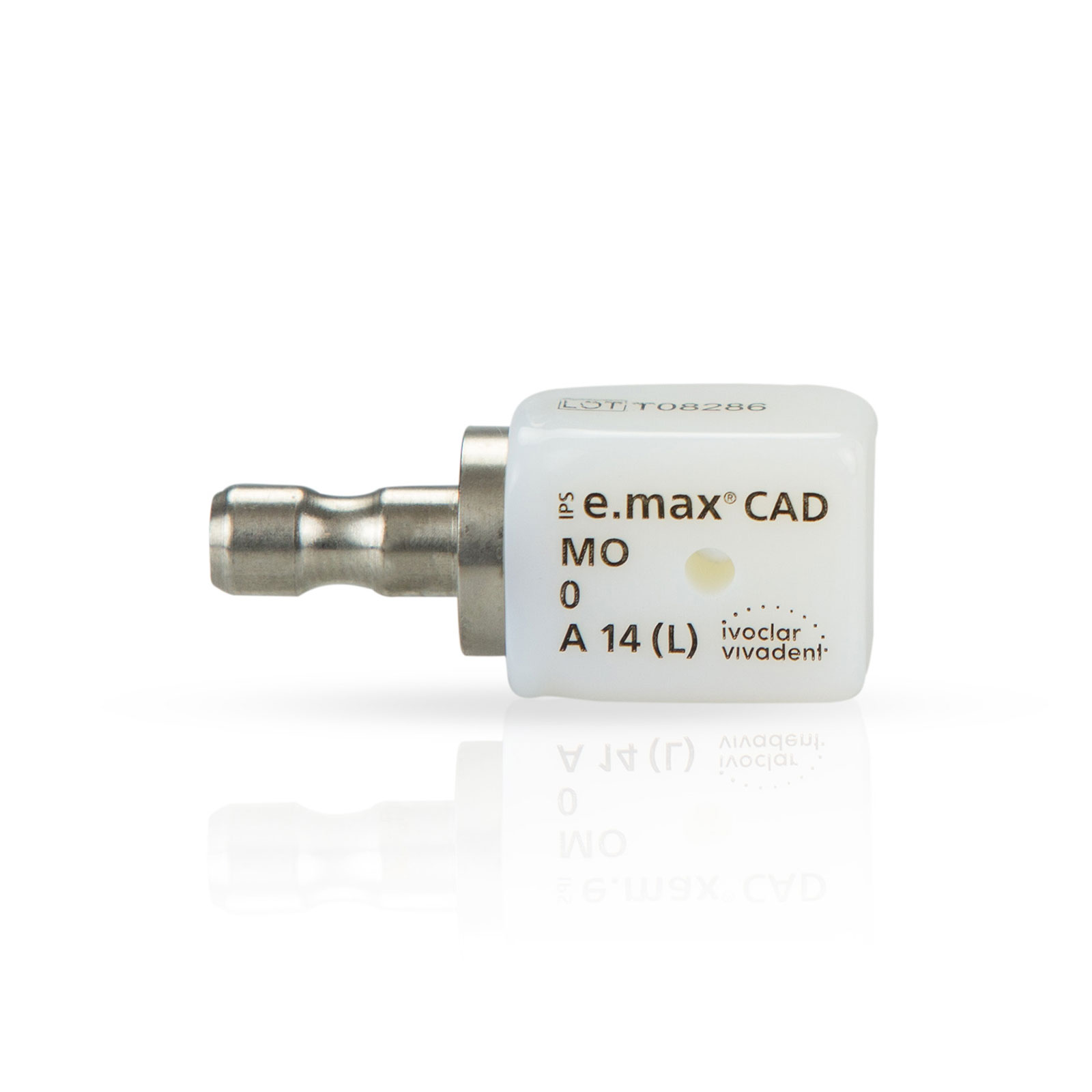
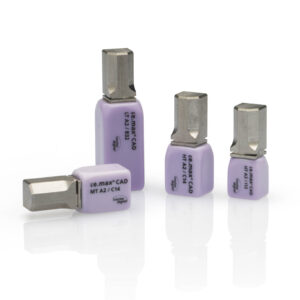
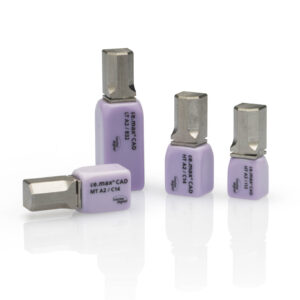
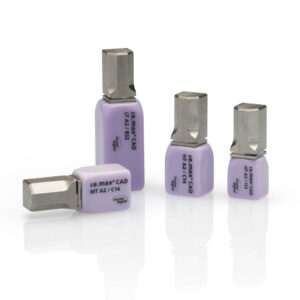
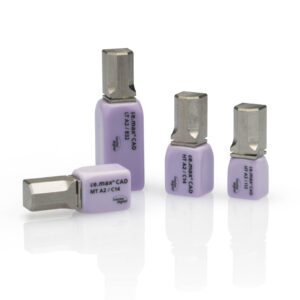
Lithium disilicate glass-ceramics (LS2). IPS e.max® CAD is the best-selling glass-ceramic[1] worldwide. The material enables the efficient fabrication of full-contour restorations. It is distinguished by its flexibility, versatile field of applications and processing options and its high strength of 530 MPa[2].
Both its esthetic properties and durability have been confirmed in everyday clinical practice [3-5].
Processing options: �e::
- polished and crystallized
- glazed and crystallized in a single step
- stained, glazed and crystallized in a single step
Types of restorations:
- Minimally invasive crowns (1 mm)[6], crowns
- Three-unit bridges (up to the second premolar as the terminal abutment), implant-supported hybrid abutment restorations (hybrid abutments[7], hybrid abutment crowns) – veneers and occlusal veneers
- Inlays, onlays, partial crowns
Benefits:
- Excellent esthetics and high flexural strength of 530 MPa[2]
- 97.2% survival rate of posterior crowns over a period of 10 years[8]
- Efficient grinding and crystallization of posterior crowns in only 19:17 minutes[9]
- Broad spectrum of restorations for your chairside CAD/CAM applications
- 10-year guarantee
- Suitable for conventional, adhesive or self-adhesive cementation techniques
Block sizes[7]: 6 (I12, C14, C16, B32, B40 and B40 L) and 2 abutment block sizes (A14, A16). Translucency levels[7]: 4 levels and 2 Impulse blocks (HT – High Translucency, MT – Medium Translucency, LT – Low Translucency, MO – Medium Opacity). Shades[7]: Comprehensive range of shades: in A–D and BL shades (the range of shades varies depending on the translucency level), see page 60–65.
Authorized CAD/CAM systems:
Ivoclar:
- PrograMill® PM3 / PM5 / PM7
- Zenotec® select hybrid
- Amann Girrbach: Ceramill® mikro ic, Ceramill® motion 2 / motion 3 / drs, Ceramill® matik
Planmeca:
- PlanMill® 30 S / 40 / 40 S
Dentsply Sirona: inLab® MC XL / MC X5, CEREC® MC / MC X / MC XL / Primemill.
[1] Based on global sales figures.
[2] Average biaxial flexural strength; outcome after more than 10 years of ongoing quality testing, R&D Ivoclar, Schaan.
[3] Fasbinder D. J et al., Study report, 2017b.
[4] Rauch A et al., Clin. Oral Investig. 2018, 22, p. 1763-1769.
[5] Boldt J, Spitznagel F. A, Dtsch. Zahnaerztl. Z. 2017, 72 (4), p. 319-325.
[6] Long-term clinical evidence and the material’s high strength allows the recommendation for crowns with a minimum layer thickness of 1 mm in combination with an adhesive cementation method.
[7] The offering varies, depending on the CAD/CAM system being used.
[8] The survival rate of monolithic IPS e.max CAD posterior crowns was evaluated with the Kaplan-Meier method. The failure rate refers to technical failures such as fractures and chipping, R&D Ivoclar, Schaan.
[9] Average grinding time of three posterior crowns, 08:07 minutes (CEREC Primemill, fast grinding mode), followed by superspeed crystallization in the Programat CS6, 11:10 minutes (HT, MT, LT / glaze spray or polishing technique), maximal two restorations, R&D Ivoclar, Schaan.
- CEREC®, inLab®, PlanMill® und Ceramill® are not registered trademarks of Ivoclar Vivadent AG